Mississippi officials reported oily tar balls washing up on their mainland shores for the first time Sunday, as authorities throughout the Gulf Coast region kept a wary eye on Tropical Storm Alex.
"It has hit our shores," said Pascagoula, Mississippi, Mayor Robbie Maxwell, adding that tar balls washed up on a nearby stretch of beach during the afternoon Sunday.
"This is what we've been expecting. We had hoped and prayed we would somehow miss this, but it's hit us now. The good news is that for the last five or six weeks we've been preparing to attack it when it hit our shores, and that's exactly what we've done," Maxwell said.
A 23-person crew was out on the beach Sunday afternoon, collecting tar balls, he said.
"Now that we have it on our shores, every day it'll have to be attacked again," the mayor added.Mississippi officials said while tar balls and glob-like "mousse patties" washed ashore in at least four locations, the areas affected were relatively small and no beaches were closed.
Meanwhile, Alex restrengthened into a Tropical Storm Sunday night as it headed into the warm waters of the Gulf of Mexico, according to the National Weather Service but it is expected to steer clear of oil-affected areas. The storm had temporarily weakened to a tropical depression as it passed over Mexico's Yucatan Peninsula.
"We think the storm is going to stay on a more southern track. That would be good news because it would avoid the area near the oil spill," said Todd Kimberlain of the National Hurricane Center.
However, forecasters have not ruled out an easterly shift in Alex's path.
"We all know the weather is unpredictable, and we could have a sudden last-minute change," said Coast Guard Adm. Thad Allen, the federal government's response manager.
The governors of Louisiana, Texas, Mississippi and Alabama declared Sunday a day of prayer in their respective states as efforts to cap the massive gusher continue.
Researchers have estimated that between 35,000 barrels -- about 1.5 million gallons -- and 60,000 barrels -- about 2.5 million gallons -- of oil are gushing into the ocean every day.
If Alex forces a work stoppage at the ruptured BP well, officials fear that as much as 2.5 million gallons of oil could flow into the Gulf for two weeks. That is because it would take 14 days to put everything back in place -- meaning the containment cap would be off for that period, allowing oil to flow freely, Allen said.
BP plans to place a third rig called the Helix Producer at the well site next week, which will increase the amount of oil being captured to 53,000 barrels a day, Allen said. That, too, could be disrupted if Alex affects the area.
Alex is the first named storm of what is expected to be a fierce Atlantic hurricane season. It formed in the Caribbean on Saturday.
Tropical storm warnings for the coast of Belize and the east coast of the Yucatan were discontinued earlier Sunday, the hurricane center said. Alex soaked Belize after making landfall in the Central American nation several hours earlier with maximum sustained winds of 65 mph.
After dropping in wind speed over the Yucatan, Alex's winds increased to 45 mph with higher gusts Sunday night, the National Hurricane Center said. The system was moving west-northwest at near 7 mph.
"Additional strengthening is forecast during the next 48 hours, and Alex could become a hurricane in the next 48 hours," the hurricane center said. Alex is expected to make landfall Thursday morning near La Pesca, Mexico.
In the meantime, forecasters said Sunday that Alex was expected to dump 4 to 8 inches of rain over the Yucatan peninsula, southern Mexico and Guatemala through Tuesday, with 15 inches possible over mountainous areas.
"These rains could cause life-threatening flash floods and mudslides," the hurricane center said.
Oil company BP said the storm has not forced any evacuations at the oil spill site. But, to the south, BP and Shell were evacuating all nonessential personnel from oil platforms as a precaution.
Gulf Coast residents feared that high winds and storm surges could spread the slick and push more oil ashore into bays, estuaries and pristine beaches, exacerbating the oil disaster triggered by BP's ruptured well.
"The greatest nightmare with this storm approaching is that it takes this oil on the surface of the Gulf and blows it over the barrier islands into the bays and the estuaries," Sen. Bill Nelson, D-Florida said. "And that is where you really get the enormous destruction, because it's just very difficult to clean up those pristine bays."
If the storm heads to the east of the oil spill, it would send the oil farther out to sea.
If the storm heads more directly toward the central Gulf and Louisiana, it might push the oil toward Florida.
"We've never been in this situation before," CNN meteorologist Karen Maginnis said. "We've never seen an oil spill that encompassed the Gulf like this, end up so close to shore." Source
Read more......
6/27/2010
Tar balls reported on Mississippi mainland; Alex heads into Gulf


Obama 'angry' after reading McChrystal's remarks
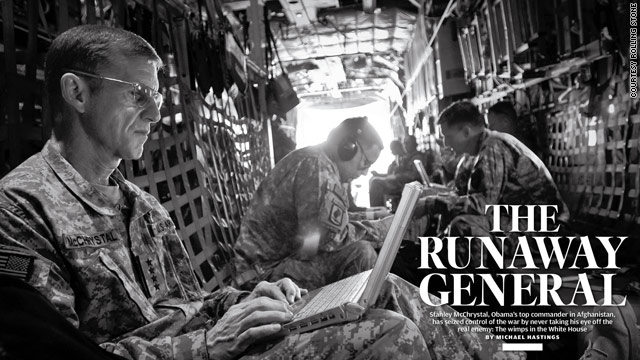
The fate of the top U.S. military commander in Afghanistan hinges on his meeting Wednesday with President Barack Obama, who was "angry" after reading the general's remarks about colleagues in a magazine profile to be published Friday.
Gen. Stanley McChrystal will likely resign, a Pentagon source who has ongoing contacts with the general said.
The "magnitude and graveness" of McChrystal's mistake in conducting the interview for the article were "profound," White House press secretary Robert Gibbs said. Defense Secretary Robert Gates said McChrystal had "made a significant mistake and exercised poor judgment."
McChrystal apologized Tuesday for the profile, in which he and his staff appear to mock top civilian officials, including the vice president. Two defense officials said the general fired a press aide over the article, set to appear in Friday's edition of Rolling Stone."I extend my sincerest apology for this profile. It was a mistake reflecting poor judgment and should never have happened," McChrystal said in a Pentagon statement. "Throughout my career, I have lived by the principles of personal honor and professional integrity. What is reflected in this article falls far short of that standard.
McChrystal has been recalled to Washington to explain his actions to the president. He is expected to meet with Obama in the Oval Office on Wednesday, Gibbs said. Gibbs refused to speculate about McChrystal's fate, but told reporters "all options are on the table." Obama, questioned about McChrystal before a Cabinet meeting Tuesday afternoon, said he had not made a decision.
"I think it's clear that the article in which he and his team appeared showed poor judgment, but I also want to make sure that I talk to him directly before I make that final decision," he said.
McChrystal is prepared to resign if the president has lost confidence in him, a national security official told CNN. Most of the Pentagon brass, the ofrficial said, hopes he will be upbraided by the commander-in-chief but sent back to continue the mission.
The White House will have more to say after Wednesday's meeting, Gibbs said. He noted, however, that McChrystal did not take part in a teleconference Obama had with Afghan President Hamid Karzai and other top officials on Tuesday.
Several elected officials have strongly criticized McChrystal but deferred to the president on the politically sensitive question of whether the general should keep his position. A couple of key congressmen, however, have openly called for McChrystal's removal.
In the profile, writer Michael Hastings writes that McChrystal and his staff had imagined ways of dismissing Vice President Joe Biden with a one-liner as they prepared for a question-and-answer session in Paris, France, in April. The general had grown tired of questions about Biden since earlier dismissing a counterterrorism strategy the vice president had offered.
"'Are you asking about Vice President Biden,' McChrystal says with a laugh. 'Who's that?'"
"'Biden?' suggests a top adviser. 'Did you say: Bite Me?'"
McChrystal does not directly criticize Obama in the article, but Hastings writes that the general and Obama "failed to connect" from the outset. Sources familiar with the meeting said McChrystal thought Obama looked "uncomfortable and intimidated" by the room full of top military officials, according to the article.
Later, McChrystal's first one-on-one meeting with Obama "was a 10-minute photo op," Hastings writes, quoting an adviser to McChrystal. "Obama clearly didn't know anything about him, who he was. Here's the guy who's going to run his f---ing war, but he didn't seem very engaged. The Boss (McChrystal) was disappointed."
The article goes on to paint McChrystal as a man who "has managed to piss off almost everyone with a stake in the conflict," including U.S. Ambassador Karl Eikenberry, special representative to Afghanistan Richard Holbrooke and national security adviser Jim Jones. Obama is not named as one of McChrystal's "team of rivals."
Of Eikenberry, who railed against McChrystal's strategy in Afghanistan in a cable leaked to The New York Times in January, the general is quoted as saying, "'Here's one that covers his flank for the history books. Now if we fail, they can say, "I told you so.'"
Hastings writes in the profile that McChrystal has a "special skepticism" for Holbrooke, the official in charge of reintegrating Taliban members into Afghan society and the administration's point man for Afghanistan and Pakistan.
"At one point on his trip to Paris, McChrystal checks his BlackBerry, according to the article. 'Oh, not another e-mail from Holbrooke,' he groans. 'I don't even want to open it.' He clicks on the message and reads the salutation out loud, then stuffs the BlackBerry back in his pocket, not bothering to conceal his annoyance.
"'Make sure you don't get any of that on your leg,' an aide jokes, referring to the e-mail."
Both Democrats and Republicans have been strongly critical of McChrystal in the wake of the story. House Appropriations Committee chairman David Obey, D-Wisconsin, called McChrystal the latest in a "long list of reckless, renegade generals who haven't seemed to understand that their role is to implement policy, not design it."
McChrystal is "contemptuous" of civilian authority and has demonstrated "a bull-headed refusal to take other people's judgments into consideration."
Sen. Byron Dorgan, D-North Dakota, became the first member of the Senate Democratic leadership to call for McChrystal to step down, telling CNN that the remarks were "unbelievably inappropriate and just can't be allowed to stand."
Senate Armed Services Committee chairman Carl Levin, D-Michigan, deferred to Obama on the question of a possible McChrystal resignation. He said the controversy was sending a message of "confusion" to troops in the field. I think it has "a negative effect" on the war effort, he said.
Senate Foreign Relations Committee chairman John Kerry, D-Massachusetts, urged a cooling off period before a final decision is rendered on the general. My "impression is that all of us would be best served by just backing off and staying cool and calm and not sort of succumbing to the normal Washington twitter about this for the next 24 hours."
Sens. John McCain of Arizona, Lindsey Graham of South Carolina, Joe Lieberman of Connecticut and Jim Webb of Virginia -- also key senators on defense and foreign policy issues -- were each strongly critical of McChrystal's remarks, but noted that the general's future is a decision for Obama to make.
Karzai weighed in from abroad, urging Obama to keep McChrystal as the U.S. commander in Afghanistan. The government in Kabul believes McChrystal is a man of strong integrity who has a strong understanding of the Afghan people and their culture, Karzai spokesman Waheed Omar said.
A U.S. military official said Tuesday that McChrystal has spoken to Biden, Defense Secretary Robert Gates, Joint Chiefs of Staff chairman Adm. Mike Mullen and other officials referenced in the story, including Holbrooke, Eikenberry and Jones.
An official at the U.S. Embassy in Kabul said Eikenberry and McChrystal "are both fully committed" to Obama's Afghan strategy and are working together to implement the plan. "We have seen the article and General McChrystal has already spoken to it," according to a statement from an embassy official, making reference to McChrystal's apology.
"I have enormous respect and admiration for President Obama and his national security team, and for the civilian leaders and troops fighting this war and I remain committed to ensuring its successful outcome," McChrystal said in the closing to his apology.
Rolling Stone executive editor Eric Bates, however, struck a less optimistic tone during an interview with CNN on Tuesday.
The comments made by McChrystal and other top military aides during the interview were "not off-the-cuff remarks," he said. They "knew what they were doing when they granted the access." The story shows "a deep division" and "war within the administration" over strategy in Afghanistan, he contended.
McChrystal and his staff "became aware" that the Rolling Stone article would be controversial before it was published, Hastings told CNN Tuesday. He said he "got word from (McChrystal's) staff ... that there was some concern" about possible fallout from the story.
Obama tapped McChrystal to head the U.S. military effort in Afghanistan in the spring of 2009 shortly after dismissing Gen. David McKiernan. Source
Read more......
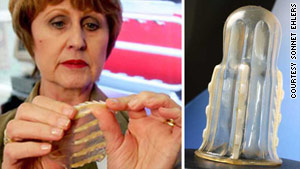
South African doctor invents female condoms with 'teeth' to fight rape
South African Dr. Sonnet Ehlers was on call one night four decades ago when a devastated rape victim walked in. Her eyes were lifeless; she was like a breathing corpse.
"She looked at me and said, 'If only I had teeth down there,'" recalled Ehlers, who was a 20-year-old medical researcher at the time. "I promised her I'd do something to help people like her one day."
Forty years later, Rape-aXe was born.
Ehlers is distributing the female condoms in the various South African cities where the World Cup soccer games are taking place.
The woman inserts the latex condom like a tampon. Jagged rows of teeth-like hooks line its inside and attach on a man's penis during penetration, Ehlers said. Once it lodges, only a doctor can remove it -- a procedure Ehlers hopes will be done with authorities on standby to make an arrest.
"It hurts, he cannot pee and walk when it's on," she said. "If he tries to remove it, it will clasp even tighter... however, it doesn't break the skin, and there's no danger of fluid exposure."
Ehlers said she sold her house and car to launch the project, and she planned to distribute 30,000 free devices under supervision during the World Cup period. "I consulted engineers, gynecologists and psychologists to help in the design and make sure it was safe," she said.
After the trial period, they'll be available for about $2 a piece. She hopes the women will report back to her.
"The ideal situation would be for a woman to wear this when she's going out on some kind of blind date ... or to an area she's not comfortable with," she said.
The mother of two daughters said she visited prisons and talked to convicted rapists to find out whether such a device would have made them rethink their actions.
Some said it would have, Ehlers said.
Critics say the female condom is not a long-term solution and makes women vulnerable to more violence from men trapped by the device. It's also a form of "enslavement," said Victoria Kajja, a fellow for the Centers for Disease Control and Prevention in the east African country of Uganda. "The fears surrounding the victim, the act of wearing the condom in anticipation of being assaulted all represent enslavement that no woman should be subjected to."
Kajja said the device constantly reminds women of their vulnerability.
"It not only presents the victim with a false sense of security, but psychological trauma," she added. "It also does not help with the psychological problems that manifest after assaults."
However, its one advantage is it allows justice to be served, she said.
Various rights organizations that work in South Africa declined to comment, including Human Rights Watch and Care International.
South Africa has one of the highest rape rates in the world, Human Rights Watch says on its website. A 2009 report by the nation's Medical Research Council found that 28 percent of men surveyed had raped a woman or girl, with one in 20 saying they had raped in the past year, according to Human Rights Watch.
In most African countries, rape convictions are not common. Affected women don't get immediate access to medical care, and DNA tests to provide evidence are unaffordable.
"Women and girls who experience these violations are denied justice, factors that contribute to the normalization of rape and violence in South African society," Human Rights Watch says.
Women take drastic measures to prevent rape in South Africa, Ehlers said, with some wearing extra tight biker shorts and others inserting razor blades wrapped in sponges in their private parts.
Critics have accused her of developing a medieval device to fight rape.
"Yes, my device may be a medieval, but it's for a medieval deed that has been around for decades," she said. "I believe something's got to be done ... and this will make some men rethink before they assault a woman." Source
Read more......
Burned girl a symbol of Roma hate and hope
Natalka Kudrikova is a bright-eyed, three-year-old girl recovering from the severe burns she suffered when far-right extremists threw a Molotov cocktail into her home.
Her family and authorities say she was targeted because they are Roma, or gypsies. Natalka lost 80 percent of her skin, two fingers (a third was later amputated) and spent months lying in an induced coma following the attack last year in Vitkov, in the Czech Republic. She is still recuperating after 14 major surgeries.
In May, Natalka returned to Ostrava Hospital for rehabilitation sessions so that one day she may be able to get around without support. "I'd rather not take her back to the hospital," said her mother, Anna Sivakova, "but if she must return, my dream is that she learns how to walk without any help."The very next day, four young men accused of attacking Natalka, filed into Ostrava District Court to hear the indictment: a racially motivated attempted murder.
According to the prosecutor, the attack was planned for the 120th anniversary of Adolf Hitler's birth. Court experts confirmed swastikas and other Nazi memorabilia were found in the defendants' homes In court, Ivo Muller and Vaclav Cojocaru described their coordinated Molotov cocktail attack. Their only excuse -- they said they thought they were attacking an empty storehouse of stolen goods.
Under cross-examination, Muller and Cojocaru admitted attending anti-Roma demonstrations organized by right wing extremists.
The other defendants, Jaromir Lukes and David Vaculik, did not take the stand. Lukes is accused of being the ringleader, a claim his defense counsel strongly denies although he concedes Lukes drove the getaway car. His lawyer also vehemently denies there was any racial motivation to the attack.
An anti-fascist website published a photo of Lukes walking next to the leader of the far-right Workers' Party. Another photo showed Vaculik wearing the armband of the Workers' Party, the public face of the Czech far right.
The leader of the now banned Workers' Party, Tomas Vandas, denied any involvement.
"Yes, we may have used those people as organizers of our public meetings but how could we know they would commit a crime?" said Vandas. "I hope Natalka gets better soon," he added.
Miroslav Mares, from Masaryk University in Brno, is the leading academic specialist on Czech extremist groups.
He thinks it's unlikely that the Workers' Party was directly involved in the arson attack, but he says they were responsible "for inflaming anti-Roma sentiment."
"Maybe some youngsters from the neo-Nazi scene said to themselves, 'If the whole population is against Romas we are justified in carrying out such attacks,'" he said.
And surveys do show anti-Roma sentiment is widespread. The European Union EURoma website says Czech Romas endure extremely high unemployment rates, low educational standards, isolation, and the prejudices of the majority population.
"In regions with high unemployment and poor social conditions, the rise of extremism is popular with unemployed young men but we can see more and more women on the neo-Nazi scene," Marek said.
Lucie Slegrova, 20, is a flag-waving militant of the now renamed Workers' Social Justice Party. She denies her party is inspired by Hitler's Nazi ideology.
Instead, she says, they follow their own nationalist ideas. "The Czech Republic should be for people who know how to behave. If the gypsies don't want to follow the rules, they're free to leave," she said.
Only one percent of Czech voters supported the Workers' Social Justice Party in the last elections, but Czech Prime Minister Jan Fischer worries that 7 percent of Czech students voted for the far-right party, according to an unofficial nationwide poll.
"A lot of people are frustrated with politicians, and have troubles due to the crisis and recession. My message to them is please think it over and don't believe these very bad prophets," Fischer said.
The far-right movement has made bigger gains in neighboring Hungary where 17 percent of voters chose the Jobbik party in the last elections.
Violence has been much worse as well. In the last two years, nine Roma have been killed in Hungary in unprovoked night-time attacks, according to the European Roma Rights Centre (ERRC).
Roma bashing also became an issue in the Slovakian election campaign. The far right Slovak National Party commissioned billboards showing a dark-skinned man with tattoos and an inflammatory message: "Vote SNS so we don't feed those who don't want to work."
In eastern Slovakia many Roma live in segregated communities like the village of Ostrovany where municipal authorities spent some $16,000 to build a wall separating the Roma from their white neighbors, because of fears of "alleged Roma crime," said Stanislav Daniel from ERRC.
"To me the wall is a symbol of segregation because public finances were used to target a stereotype, not what's real," Daniel said.
The wall separates a tidy town from a rural slum. Roma, living right next to the wall, have no sewage or garbage collection and there's just one tap with drinking water for dozens of families.
Back in the Czech Republic, Natalka's father, Pavel Kudrik, has chosen to stay in the region and rebuild a comfortable home for his wife and four daughters.
After police asserted that Natalka's family were victims of a racist attack, many Czechs opened their wallets and their hearts.
Prime Minister Fischer's wife and son spearheaded a nationwide campaign to help them -- a move that led to the Fischer family having full-time police protection after they received anonymous death threats.
But the current climate is not the only reason Fischer wants to clamp down on right wing extremism.
Everyone in his family died in the Holocaust except for his father and grandmother. "Sixty-five years after WWII, the societal memory is getting weak," he said.
And Roma activists complain that recognition of their sacrifices under the Nazis has never been properly acknowledged.
Half-a-million Roma perished in what they call the "Devouring" -- Hitler's campaign to eliminate them as a people.
Last May, several hundred Czech Roma gathered at a memorial for the victims of the Lety concentration camp. Hundreds of Czech Roma children died there and are buried nearby in a mass grave.
Jan Vrba is one of the camp's last survivors. He was born there. His sister perished there.
"What happened in Vitkov made me cry", said Jan. "Little Natalka reminded me of my sister who died in this camp." Source
Read more......

A year after Neda's death, Iran movement continues
A year ago Sunday, Neda Agha-Soltan died of a single gunshot wound to the chest. Her last moments -- captured on a cell phone camera and shown around the world-- catapulted her into the symbol of the postelection reform movement in Iran.
Today, the Iranian regime's crackdown seems to have driven protesters off the streets. But the movement is not weakening, some analysts say. Instead, it's evolved into an online underground civil rights struggle, they say.
"I think they're going to continue to move forward, whether in the form of a green movement or another type of movement," said Karim Sadjadpour, a fellow at the Carnegie Endowment for International Peace. "It's just, basically, this march of history."Agha-Soltan, 26, was at an anti-government demonstration in Tehran when she was felled by a single bullet to the chest.
"She has been shot! Someone, come and take her!" shouts one man in the shaky cell phone video that has since been seen around the world.
The video then shows blood streaming from her mouth, then from her nose. Her eyes roll to her right; her body is limp.
A man, who had accompanied her to the rally, is then heard pleading with her by name.
"Neda, do not be afraid, do not be afraid," he repeats.
Agha-Soltan was taken to a nearby hospital and, within a day, she was buried at Behesht Zahra, the city's largest Muslim cemetery, on the outskirts of the capital.
Immediately afterward, she emerged as the face of the anti-government movement.
Even world leaders took notice.
"We've seen courageous women stand up to the brutality and threats and we've experienced the searing image of a woman bleeding to death on the streets," said President Barack Obama.
Eight days before Agha-Soltan's death, Iranian President Mahmoud Ahmadinejad's landslide election victory unleashed massive demonstrations in the country.
Thousands of green-clad protesters took to the streets, accusing the government of rigging the elections.
Iran's leaders called the uprising a foreign-led plot to overthrow the regime. It cracked down on the protesters -- with many killed and even more jailed.
Images of the bloody crackdown fueled worldwide outrage. Agha-Soltan's pictures are still carried on placards at rallies outside Iran.
"She will become the image of this brutality, and of the role -- the truly significant role -- that women have played in fighting this regime," said Abbas Milani of Stanford University in California. "I think that women are the unsung heroes of the last few years. They are the ones who began chipping away at the authority, the absolute dictatorship of the mullahs."
Iranian authorities continue to deny that security forces were responsible for killing Agha-Soltan.
Instead, they have offered at least three separate explanations. They have blamed the CIA, terrorists and supporters of the opposition movement themselves.
One year after Agha-Soltan's death, Iranian officials have yet to announce a single arrest in connection with her killing. Source
Read more......
